

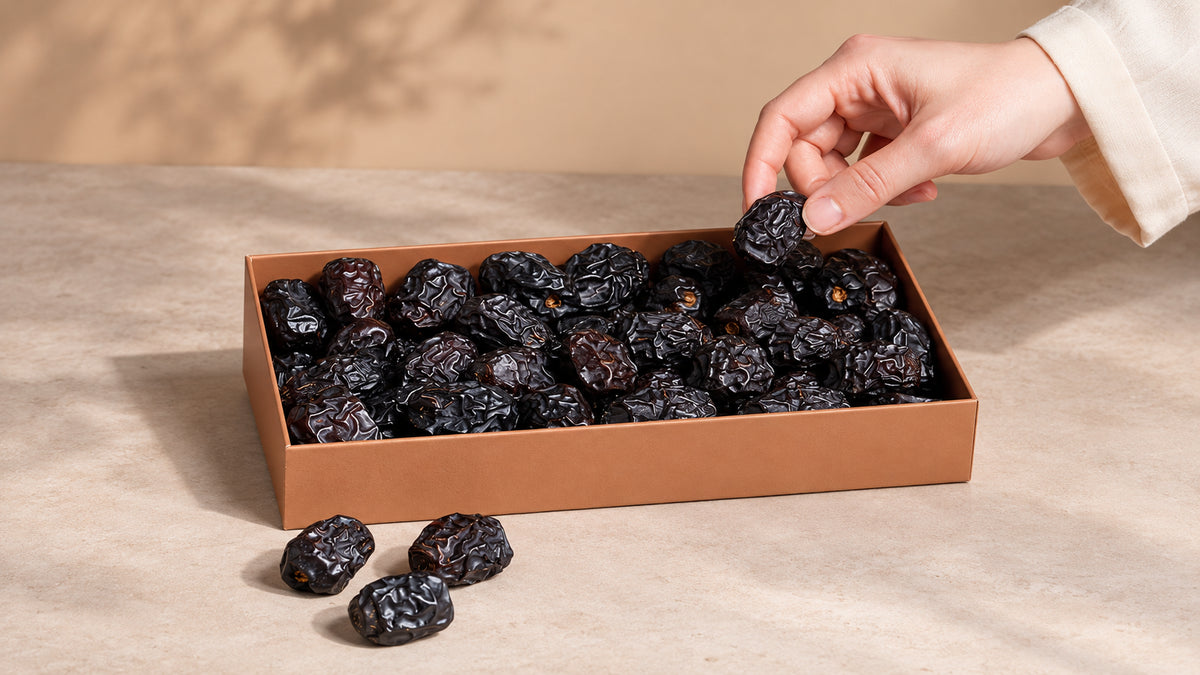
The date from Medina - why it's different, what it tastes like, and why people seek it out.
Hi Mejdoolers,
If you've spent any time in a Middle Eastern grocery store, you've probably seen Ajwa dates - small, dark, almost black, and usually priced higher than everything else on the shelf. They're not the biggest date, not the softest, and not the sweetest. But they have a following unlike almost any other variety, and for reasons that go well beyond nutrition. Here's what you should know.
Ajwa dates come from Medina, Saudi Arabia - specifically the date palm plantations surrounding the city. They're one of the oldest cultivated date varieties in the region, and that origin matters: Medina's soil, climate, and centuries of agricultural tradition produce a fruit that can't quite be replicated elsewhere. While date palms grow across the Arabian Peninsula and North Africa, authentic Ajwa from Medina is a specific thing - and what you'll find labelled "Ajwa" at a reputable supplier should trace back there.
They're harvested once a year, with peak availability in the fall, though they're sold dried year-round.
Ajwa dates are small and dark - almost black - with a glossy, slightly wrinkled skin. The texture is soft and tender, not firm or dry. The flavour is mild in sweetness with a deep, fig-like quality and subtle earthy notes - complex without being intense. They're not as sweet or as rich as a Sukkari Gaf, and they're softer than you might expect given their dark exterior. That combination of softness and depth is part of what makes them distinctive.
The pit is long and often removed before packaging, which is worth knowing if you're using them in a recipe.

The honest answer is that it's cultural, religious, and culinary all at once. Ajwa dates have a direct association with the Prophet Muhammad in Islamic tradition - they're mentioned in hadith, eaten during Ramadan iftar, and given as gifts during religious occasions. For Muslim households, Ajwa isn't just a food - it carries meaning. That's not a marketing angle; it's a real part of why demand for them remains consistent year-round, and why people will pay significantly more for Ajwa than for other varieties of similar size.
That said, you don't have to have any religious connection to appreciate them. The flavour profile alone is worth trying - especially if you've mostly eaten Medjool and want to understand how different dates can actually taste.
A few comparisons that are actually useful:
Per 100g, Ajwa dates provide roughly 350 calories, 82g of carbohydrates, 7.5g of fibre, 2.5g of protein, and around 875mg of potassium - a strong number by any standard. They also contain calcium and iron, though amounts vary by source and growing conditions. Like all dates, they're naturally high in sugar, so they're best understood as a nutrient-dense whole food rather than a low-sugar snack.
Claims about Ajwa dates and disease prevention circulate widely online. Most of them aren't well-supported by peer-reviewed research - we're not going to repeat them here. What's well-established is that they're a whole food with a solid fibre and mineral profile, which is genuinely useful on its own.
Most people who seek out Ajwa eat them as they are - on their own, as a small daily ritual, often first thing in the morning or to break a fast. The traditional practice is to eat an odd number (three or seven is common in Islamic tradition), though there's no nutritional reason to follow that specifically.
They also work well paired with Arabic coffee or tea, where the bitterness of the drink balances their sweetness nicely. Because they're firmer than Medjool, they hold up well as a stuffed date - try them with a piece of walnut or almond pressed inside.
In cooking, their denser texture makes them a decent choice for blending into date paste or sauces, though their darker colour will affect the final appearance of lighter-coloured dishes.
Ajwa dates are widely available at Middle Eastern grocery stores across North America. When buying, look for dates labelled as originating from Medina, ideally with a producer or region of origin noted. Generic "Ajwa" without provenance information is common and harder to verify for quality.
We carry Ajwa dates at Mighty Mejdool and ship across Canada and the US - they're currently out of stock, but check the product page or sign up to be notified when they're available again. We source carefully, and Ajwa is no exception.
Stay Mighty,
The Mighty Mejdool Team
Share:
3-Ingredient Sukkari Gaf Date Fudge
You’ve Had Medjool. Here’s What You’re Missing